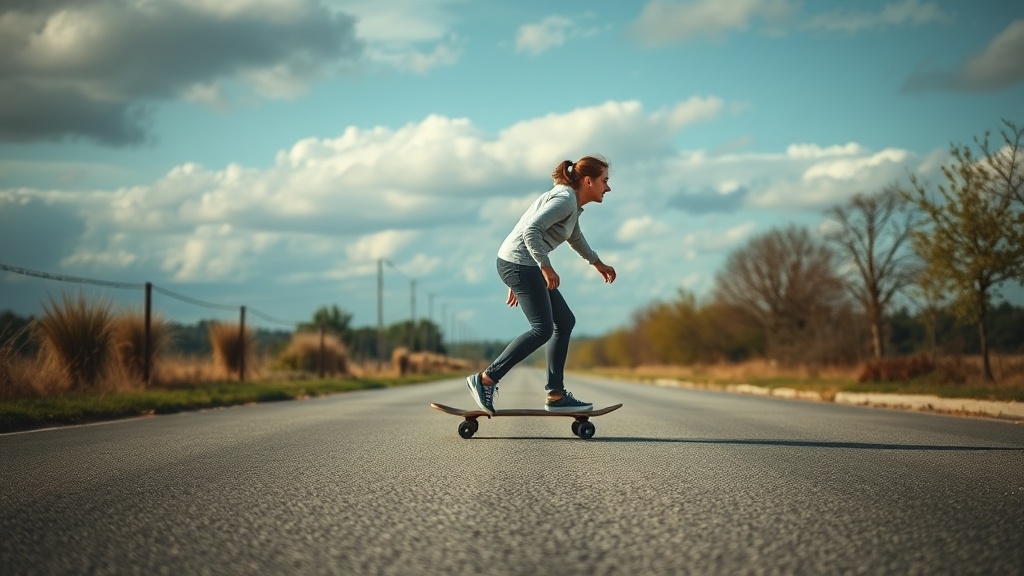
Balance Drills for Longboarders Who Want to Stop Wobbling on Uneven Pavement

You're halfway down the block when a crack in the sidewalk sends your arms flailing
We've all been there — that split-second where your board hits uneven pavement and your brain screams correct this now while your body does something entirely different. The wobble starts small. Then it grows. And suddenly you're stepping off or — worse — grabbing pavement with your palms. Balance isn't just about standing still on a board. It's your body's ability to make micro-adjustments when the surface beneath you refuses to cooperate. This matters more as you push longer distances, tackle varied terrain, or simply try to look less like a beginner on your commute through Brooklyn's cracked sidewalks.
The good news? Balance is trainable. Not through vague advice like "just ride more" — but through specific drills that challenge your proprioception (your body's awareness of where it is in space) and strengthen the stabilizer muscles that keep you upright when things get weird. Below are practical drills you can do without fancy equipment, plus the why behind each one so you actually stick with them.
What single-leg exercises actually transfer to longboarding stability?
Standing on one leg in your living room is fine — but it doesn't replicate the dynamic demands of longboarding. You need single-leg work that mimics the subtle weight shifts and reactive demands of riding. Start with the single-leg Romanian deadlift. Stand on your right foot, hinge at the hips while extending your left leg behind you, and reach toward the ground. The key isn't depth — it's control. Your ankle will wobble. Your knee will drift. That's the point. These small corrections mirror exactly what happens when your board hits a pebble at speed.
Do 3 sets of 8-10 reps per leg, moving slowly enough that you feel every adjustment your body makes. When this gets easy, add a challenge: hold a light weight in the opposite hand, or stand on an unstable surface like a folded towel. The instability forces your ankle stabilizers — particularly the peroneal muscles on the outside of your lower leg — to work harder. These same muscles fire when you're carving or recovering from a speed wobble.
Another drill: the clock reach. Stand on your right leg and tap your left toe to positions around you like the numbers on a clock — 12 o'clock, 3 o'clock, 6 o'clock, and back. This trains hip stability and challenges your balance in multiple planes, not just the forward-back motion we're used to. Longboarding demands lateral stability too — especially when shifting weight between heelside and toeside turns.
How can I train my eyes and inner ear to prevent speed wobbles?
Speed wobbles aren't just a board problem — they're a sensory problem. Your vestibular system (inner ear) and visual system work together to tell your brain where you are. When they get confused — say, when you're looking down at your feet instead of where you're going — your balance suffers. One of the most effective drills comes from physical therapy: gaze stabilization exercises.
Stand on one leg (near a wall for safety). Hold your thumb at arm's length and focus on your thumbnail. Move your head slowly side to side — like you're shaking your head "no" — while keeping your thumb clear and steady in your vision. Start with small head movements and gradually increase the range. This trains your vestibular system to stay calm even when your head moves, which happens constantly while longboarding over rough surfaces.
Progress this by adding a balance challenge: stand on a pillow or folded yoga mat while doing the same drill. The combination of unstable surface + head movement + visual focus replicates the sensory overload of bombing a hill or navigating a cracked sidewalk. Do this for 30-60 seconds per leg. Most people feel noticeably more stable on their board within two weeks of consistent practice.
For visual training specifically, practice far-near focusing while balancing. Stand on one leg, focus on something 20 feet away, then quickly shift focus to your thumb at arm's length. Alternate back and forth. This trains your eyes to adjust quickly — a skill you'll need when scanning the road ahead for obstacles while still monitoring your foot placement.
Why do my ankles give out before my legs get tired?
If you've ever ended a session because your ankles felt "done" while your quads still had gas in the tank, you're experiencing a common imbalance. Most of us train the big movers — quads, glutes, calves — while ignoring the small stabilizers that keep our ankles from rolling. The tibialis anterior (the muscle on the front of your shin) is particularly neglected. It's what pulls your toes up, and it's crucial for absorbing impacts and maintaining dorsiflexion while riding.
Try tibialis raises: stand with your back against a wall, feet about a foot away from it. Without lifting your heels, raise your toes toward your shins as high as possible. Lower slowly. Do 3 sets of 15-20 reps. This muscle gets hammered during foot braking and when absorbing cracks — strengthening it prevents the "ankle burn" that cuts sessions short.
Another overlooked area: intrinsic foot muscles. These small muscles in your feet provide the fine-tuned balance adjustments that keep you on your board when things get sketchy. Train them with toe yoga: stand barefoot and try to lift just your big toe while keeping the other four down. Then switch — press the big toe down and lift the other four. It sounds simple. Most people can't do it cleanly. Practice until you can, then progress to doing it while standing on one leg. Strong feet mean better board feel and faster reactions when you hit unexpected terrain.
For a more dynamic challenge, try the balance beam walk — but do it backwards. Find a curb or painted line about 4-6 inches wide. Walk heel-to-toe backward along it. This forces your ankle stabilizers to work in an unfamiliar pattern, building resilience that translates to recovering from unexpected shifts on your board. When forward walking gets easy, close your eyes (safely, on flat ground with a spotter). Removing visual input forces your vestibular and proprioceptive systems to step up.
Can balance training make me a better pusher?
Push mechanics suffer when your stance leg isn't stable. Every push requires you to balance on one foot while the other swings forward, makes contact, and propels you. If your stance leg wobbles, your push becomes inefficient — you lose power, waste energy correcting, and fatigue faster. Targeted balance work fixes this.
The skater stance hold mimics your pushing position perfectly. Stand in your natural longboard stance — front foot at a slight angle, back foot positioned as if you've just finished a push. Hold this position for 30-60 seconds. Notice where your weight sits. Most people lean too far back or let their stance knee cave inward. Consciously correct these patterns. When static holds get easy, add perturbations: have a friend lightly tap your shoulder from random directions, or bounce a ball against a wall and catch it while holding your stance. The unpredictable disturbances force reactive balance — exactly what happens when you hit a crack mid-push.
Another sport-specific drill: single-leg hops with stick. Stand on your stance leg holding a broomstick or light pole horizontally. Hop forward, landing softly on the same leg while keeping the stick level. The pole acts as a visual feedback tool — if it tilts, you know your balance was off at landing. Do 3 sets of 5 hops per leg, resting fully between sets. This builds the explosive single-leg stability needed for powerful pushes and quick recoveries.
For an integrated challenge, combine balance work with your actual riding. Find a slight incline and practice slow-speed balance — riding as slowly as possible without putting a foot down. This is harder than it sounds and builds the micro-adjustment skills that keep you upright when terrain gets rough. Alternate between regular and switch stance to develop symmetry. Most longboarders have a dominant pushing leg that gets all the stability training while the other atrophies. Symmetrical balance reduces injury risk and opens up switch riding possibilities.
How often should I do these drills — and when will I see results?
Consistency beats intensity. Ten minutes of focused balance work, three times per week, outperforms a single hour-long session. Your nervous system adapts to balance training quickly — but it also detrains quickly if you stop. Think of it like brushing your teeth: small, regular doses.
The best time to do these drills? After your legs are already slightly fatigued from riding or lower-body training. Fatigued balance work has better carryover to real-world riding because — let's be honest — your legs are never fresh when you're an hour into a long push session. That said, don't do highly unstable drills when exhausted. Save the eyes-closed, unstable-surface work for when you're fresh enough to be safe.
Most riders notice improved stability within 2-3 weeks. The first changes are usually mental — you feel more confident before you can articulate why. Then you'll catch yourself recovering from wobbles that would have sent you stepping off a month ago. After 6-8 weeks, the adaptations become more structural: stronger ankles, better hip stability, improved single-leg strength that shows up in longer sessions and smoother carving. Stick with it. The pavement isn't getting any smoother — but your ability to handle it can always improve.