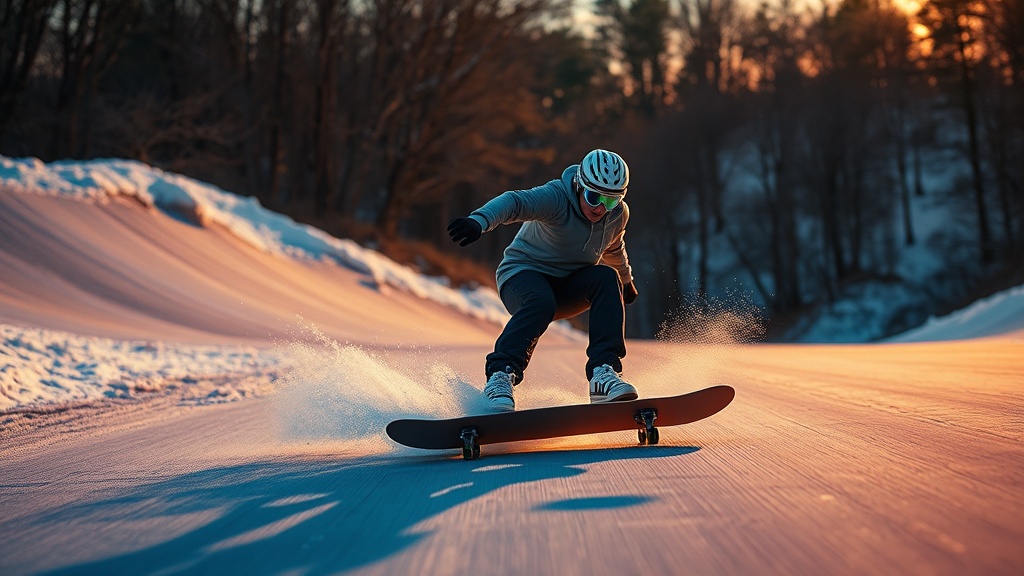
Master Longboarding: Essential Training Drills for Every Skill Level

Whether you're pushing for the first time or trying to lock down a toeside 180 slide, structured training drills separate casual riders from confident longboarders. This post covers progressive exercises for beginners finding their balance, intermediates refining technique, and advanced skaters pushing into slides and downhill. You'll walk away with specific drills you can run today — no fluff, no gear you don't need.
What are the best longboarding drills for beginners?
The best drills focus on balance, foot placement, and low-speed control. You don't need hills. You don't need slide gloves. Just a flat parking lot and twenty minutes.
Start with the static stance drill. Place the board on grass or carpet so it won't roll. Step on, find your footing, and hold for thirty seconds. Bend your knees — more than feels natural. Your center of gravity should sit low, over the trucks. Shift weight between your front and back foot. Get comfortable being uncomfortable.
Once that feels stable, move to pavement for the push-and-coast. Give one solid push, then ride it out until you stop. Don't worry about speed. Worry about staying relaxed. Tension in your ankles travels up to your hips and throws off your line. The catch? Most beginners push mongo (back foot) because it feels easier. Don't. Learn regular stance early — front foot stays planted, back foot pushes. It'll save you relearning later.
Next, the carving circle. Find an empty lot and ride in a wide circle, leaning heel-side then toe-side. Imagine you're on a surfboard — hips lead, shoulders follow. This builds the muscle memory for turning without kicking. Do ten circles clockwise, ten counter-clockwise. If you can't complete a full circle without stepping off, widen the arc.
How do you progress from cruising to controlled sliding?
Controlled sliding starts with understanding weight distribution — specifically, how to unweight your wheels enough to break traction without washing out entirely. It's not about speed. It's about commitment.
Before you slide, master the pre-slide stance. Ride at moderate speed, crouch low, and practice shifting your weight backward while keeping your front foot angled across the deck. Your back hand should hover near the ground (wear slide gloves — Muir Skate stocks reliable sets from Loaded and Sector 9). This position — low, coiled, ready — is where every Coleman or hands-down slide begins.
The first slide to learn is the Coleman slide (also called a shutdown slide). It's a heelside 180 used for speed control. The movement breaks down into phases:
- Setup carve — a deep heelside turn that loads your weight
- Crouch and reach — drop your center of gravity, extend your uphill hand
- Initiate — kick your back foot out while leaning back
- Control — let the board swing 180 degrees under you
- Ride out — shift weight forward and roll away switch
Worth noting: most people bail on step three. They hesitate, lean too far back, and high-side onto their hip. The fix? Practice on a gentle slope first — something you can bomb without sliding at all. Get the mechanics dialed slow before you add speed.
For gear, a drop-through deck like the Landyachtz Switchblade lowers your center of gravity and makes slides more predictable. Pair it with Orangatang Stimulus wheels (80a for learning, 86a once you're consistent) and Paris V3 180mm trucks. This setup forgives mistakes.
What drills help with downhill longboarding and speed control?
Downhill demands precision at velocity — small errors become big crashes. The drills here build the reflexes and body position you need before you chase thirty miles per hour.
Begin with tucking practice. The aerodynamic tuck isn't just for racing; it stabilizes you at speed. Stand on flat ground, feet parallel near the front bolts, back knee tucked behind the front calf, torso low and forward. Your front arm should tuck behind your back, back arm extended or across your chest. Hold this position for sixty seconds. It's awkward. That's the point. You need this posture to feel automatic before you're hurtling down a hill.
Next, the pre-drifting drill. Find a mellow hill with a clean runout. Ride down at moderate speed and practice the setup carve — a deep turn that scrubs speed and sets your line for what's ahead. Alternate between heelside and toeside setups. The goal isn't to slide; it's to feel how edge control bleeds momentum.
Once setup carves feel natural, progress to shutdown slide repetition. Bomb a short hill, Colemanslide to a stop at the bottom, walk back up. Repeat ten times. This ingrains the slide reflex — when something goes wrong at speed, your body should default to a controlled shutdown, not panic.
Drill Progression Overview
| Skill Level | Primary Focus | Key Drills | Recommended Setup |
|---|---|---|---|
| Beginner | Balance & Stance | Static stance, push-and-coast, carving circles | Any drop-through or pintail, 70mm+ wheels |
| Intermediate | Turning & Control | Tight carving, foot braking, switch riding | Topmount or drop-through, mid-duro wheels (80a-86a) |
| Advanced | Sliding & Speed | Coleman slides, pre-drifting, tuck practice | Stiff downhill deck, hard wheels (86a-90a), precisions |
That said, don't rush the progression. Skaters who jump to sliding before they can ride switch comfortably often develop bad habits — habits that limit how technical they can get later. Spend time riding your board backward. Push mongo (just for practice). Get weird with it.
How often should you practice longboarding drills?
Quality beats quantity. Three focused twenty-minute sessions weekly will advance you faster than one long, unfocused ride on weekends. Longboarding is skill acquisition — your brain needs time to consolidate movement patterns between sessions.
Structure your practice. Warm up with five minutes of easy cruising. Drill specific techniques for fifteen minutes — pick one thing and obsess over it. Cool down with free riding, applying what you just worked on organically. If you're training slides, wear pads and expect to fall. Triple Eight makes solid certified helmets and knee pads that won't break the bank.
Cross-training helps too. Skateboarding (parks and street) improves board control and confidence. Surfing or snowboarding develops the same weight-shift instincts. Even yoga — specifically hip openers and ankle mobility work — translates directly to better form on the deck.
Sample Weekly Training Split
- Monday: Balance and stance drills (flat ground, 20 min)
- Wednesday: Carving and turning practice (gentle hills, 30 min)
- Friday: Sliding technique or speed control (appropriate terrain, 45 min)
- Saturday: Free ride — apply skills, film yourself, review
Here's the thing about filming: you think you're low in your tuck until you watch footage. You think your slides are 180 degrees until you see the video. Record every session. The gap between how skating feels and how it looks is usually where your next breakthrough hides.
For community and spot recommendations in the Brooklyn area, connect with r/longboarding or local groups like the NYC Longboarding crew — they organize group pushes through Prospect Park and know which streets are currently smooth (and which to avoid). Riding with people better than you accelerates progress. You'll copy lines you wouldn't have imagined, pick up etiquette for sharing hills with cars, and — let's be honest — have more fun.
The drills above work. They've worked for thousands of skaters progressing from wobbly first pushes to clean standup slides. But drills without repetition are just theory. Pick one exercise from this post, block out twenty minutes tomorrow, and run it until your legs burn. Then do it again next week. The board rewards consistency — maybe not immediately, but eventually, and always when you need it most.